To those foodies and gourmands who like or love to try new restaurants, rejoice. En Route has published its annual restaurant guide, which includes an article on Canada's 10 Best New Restaurants of 2009. I serendipitously discovered this guide last year on an Air Canada flight to Ottawa in November; until last year I hadn't flown on a November since I was 3. The rest of the guide indicates restaurants that are still quite noteworthy and at least worth trying, and it also includes past 10 Best New Restaurants from previous years.
Last year's #1 new restaurant in Canada according to En Route was Nota Bene. Not only did my sister beat me to trying that restaurant, she "taunted" me about how good it was there. At least this time around I'll be able to try a top 10 restaurant with her; we're eyeing the Black Hoof when I join her in Toronto during my vacation. Keep your eyes peeled for a review on either of our blogs.
Wednesday, 28 October 2009

Monday, 19 October 2009
Soupin' Up for the Fall
Oh, there were several possible factors that motivated me to make some suit for the first time in a while, and a slow-cooked one for the first time ever. Perhaps it was my sudden realization that I hadn't done any experimental cooking since this spring. Perhaps it was the bout of snow my city got last week. Perhaps it was my sister showcasing a slow-cooked soup she made herself recently. Perhaps it was my sister reminding (taunting?) me this weekend how I've been missing out on some finer foods and especially more exotic and/or unique ingredients that at times can only be found in large cities. In any case, the urge to experiment had sprouted and had to be nurtured to fruition.
My inspiration at one of my local supermarkets this weekend was oxtail. Though there is a definitely Chinese version of oxtail soup, my first thought upon seeing oxtail pieces was my childhood experiences of Hong Kong-style Western cuisine, of which my memory of oxtail soup was most vivid. HKW cuisine is essentially fusion cuisine with a slant that's more suited to Chinese tastes. and often than not feature ingredients that are either frequently in Chinese cuisine or are readily recognized as foreign derivatives of Chinese ingredients. With an inspiration and a memory in hand, I proceeded to create my own rendition of oxtail soup. I'll admit now that my method of making this soup was restricted by what I could easily get in town; a traditional southern Chinese version of oxtail soup with certain Chinese herbs was very impractical for me to make, and I've yet to start stocking up on those items from my Winnipeg daytrips.

Behold, a (large) sample of the final product! Though in hindsight cabbage could've been used here, I didn't buy any nor had any leftover to put in the soup. However, I did have plenty of celery from making some chicken thigh stew the previous weekend; carrots I had to buy during my weekly grocery run. To further add a Western twist to this dish I also added some pot barley and bay leaf into my soup. The oxtail meat easily fell off the bone after being cooked for about 4 hours, though perhaps I should caution that this cut of beef, with some gelatinous texture and, of course, a few large bones, may not be for everybody. If you're not a fan of oxtail, you could substitute with other bony cuts, and it doesn't have to be beef at all; with the soup my sister described in her blog, she used pork shoulder instead.
With this experimentation, I must confess I've failed on two points. First, in hindsight I could've added some more vegetables, such as cabbage and tomato. The second and arguable the bigger mistake of the two was that I didn't bother trimming the fat that was present on the larger oxtail pieces; I'll have to remember that next time. I didn't blanch the meat beforehand like my sister did with her pork shoulder in her soup, but I was able to skim off the surface the foam that naturally comes from boiling chunks of meat. Next time I could try adding other ingredients that could bring different flavours to the soup as well; for some reason Ancho chilis come to mind right now.
Below is essentially what I did. Feel free to experiment with other vegetables, herbs and/or flavourings to suit your particular tastes.
Andrew's Fusion Oxtail Soup
~1.5kg (~3.0lbs.) oxtail bones (preferably the larger, meatier pieces)
~1.5kg (~3.0lbs.) mix of vegetables, cut into bite-size pieces (e.g. carrots, celery) or shredded (e.g. cabbage)
1-2 bay leaves
75mL (1/3 cup) pot barley
3 litres of water (preferably filtered)
Salt & pepper to taste
In a large stock pot add oxtail bones to the water and bring to a boil for about 5-10 minutes. In the meantime, cut up the vegetables. (If using celery, save the yellow portions in the heart, especially the leaves; they themselves can help flavour the soup.) After the water has taken its time to boil, skim off the foam on the surface of the boiling water with a small sieve.
Add vegetables, bay leaves and barley to water and bring it back to a boil. Cover and let simmer for about four (4) hours on medium-low heat. If you've added something starchy to the soup mixture such as barley or potatoes, stir occasionally to prevent sticking to the bottom of the pot, which will result in burning which can easily ruin the flavour of the soup.
Just before the soup's ready to be immediately served, add salt and pepper to taste. The soup can be served with the meat and vegetables on the side or, if served as a meal, in a large bowl with the broth itself.
Sunday, 11 October 2009
Lured Back to Little Italy
The last time I ate in Winnipeg's Little Italy was the summer of 2008 when I tried a Vietnamese restaurant there. Before that, it was in the autumn of 2006 when my parents and I accidentally discovered the wonderful and aptly named Glutton's, which alas! became no more after Chef Makoto Ono left to set up a restaurant in Beijing in 2008. The building in which Glutton's stood is now home to Mise; Mise has apparently kept Glutton's grocery store which under the old name was small but featured some of the more unique, exotic and/or higher-end items that were typically harder to find in the rest of Winnipeg, such as Greaves Jams & Marmalades from Niagara-on-the-Lake, ON. In spite of the name, Little Italy is culturally diverse with restaurants featuring other ethnic or cultural foods other than Italian dotted here and there along Corydon Ave. One of the noticeable additions to that street in the 2009 dining guide year was Italian, though.
Fazzo features contemporary Italian cuisine in a relaxed atmosphere. Don't even bother thinking about pizzas when you enter this bistro, not even thin-crust ones; they're just not on the menu. Dinner main courses here are either pasta dishes or actual entree dishes with a featured meat and the customary veg and starch sides, while the lunch menu offers sandwiches, salads or, to my pleasant surprise, frittatas. Unlike other Italian dining joints where I've eaten to date, this place had a comparatively short menu, which was fine by me as I already had a tough time deciding between a few dishes, and I anticipated the chef would then be able to better focus on the quality of the dishes he/she created.

For my appetizer I was torn between the pan-seared scallops and arancini. In the end I went for the scallops partly since the server suggested it was good and partly because, though I was tempted to try those fried delights, I didn't want to feel stuffed before the main course arrived as the server noted there would've been three fairly large arancini to tackle (my sister will likely remember my experience with polenta at Bertoldi's in London, ON). I was slightly caught off guard by the saltiness of the seared sides of the scallops; it wasn't overpowering, but it was instantly noticeable. However, the subtle sweet and sour flavours of the tomato jam and the cool smoothness of the creamed leeks countered it nicely. Though only the white parts were used in the creamed leeks, the dark green parts still got to perform in this dish as a flavourful garnish in fried thin strands. The fried leek strands provided a hint of crispiness to contrast the soft and smooth textures of the scallops, creamed leeks and tomato jam.

I also had some difficulty picking a main course dish, but in the end, with my being in the mood for something relatively light and to go with the scallops I had for starters, I went for the sablefish (aka black cod or butterfish), which came served as a fillet with the skin made crispy. The meat of the fish was flaky yet moist, melted in my mouth and had a strong flavour thanks to its high oil content. Though I couldn't resist the crispy skin I found it to be just as salty as the seared sides of the scallops from the previous dish; at least the meat itself helped temper that saltiness. Fried bits of what I suspect was parma ham were sparkingly sprinkled amongst the cipollini onions and crushed new potatoes, and until that evening I'd never had, let alone seen, white beets.
Dessert selection here was limited and none of the items called upon me, so I skipped dessert this time around. I wouldn't suggest skipping this place, though. It's a cosy little place that exposes one to the joys of contemporary Italian cuisine. I was, however, a little bit surprised that I encountered two dishes where I felt there were some elements that were saltier than I anticipated and expected to be, though in fairness to the chef, I've grilled and eaten enough scallops to know they can taste saltier when seared compared to, say, simply stir-fried. Considering this was my first and as of yet my only visit to this place, I can't say for certain now if it was just a fluke or if this place is a bit more liberal with the use of salt on some of its food items.
Name: Fazzo
Address: 905 Corydon Ave., Winnipeg, MB
Cuisine: Contemporary Italian
Price Range: Lunch $10-$30; Dinner $20-$55
Accessible: Yes
Monday, 7 September 2009
Discovering a Little Out-of-the-Way Place for Tropical Dining
Hot and humud summer weather, though late in coming, has finally arrived in Manitoba, which for one thing gave me a good excuse to make some homemade lime soda. On my Labour Day weekend daytrip to Winnipeg I thought it was a good time to get my craving for Thai food satisfied, so, armed with the latest edition of TASTE Destination Winnipeg's Culinary Guide, I decided to try a new place called Sabai Thai Eatery. Unlike other places I've tried in Winnipeg to date, this restaurant is not located in a commercial area and/or amongst other restaurants. In fact, this is about two blocks west of the Little Italy commercial area and is essentially in a residential neighbourhood.
The exterior of the building may not speak much on behalf of the restaurant, but inside the restaurant it is contemporary and stylishly simple in its decor. The menu is limited to two full 8.5 x 11 pages of food items, but if quantity is sacrified to ensure quality (and the selection is fairly decent), then I have no qualms about it.

At my server's suggestion I tried the green papaya salad, a fresh, clean and zesty start to my dinner. Shredded green (or unripened) papaya has a much crunchier texture (not quite like carrots, but close) compared to ripe papaya, and green papaya shreds look translucent, reminiscent to mung bean (or glass) vermicelli. The salad dressing certainly had a zest that can fuel an appetite, but it also had quite a spicy kick to it. The ground dried shrimp helped balance the main flavours of Thai cuisine (salty, sweet, spicy and sour) in this one dish. It was a delight to eat.

For my main course I went for an old standby that I knew each restaurant would tinker slightly to make the dish its own, the pad thai; my penchant for noodles also helped influence my choice in my main course. Though to my relief this dish was milder on the spiciness factor compared to the green papaya salad, one thing that caught my eye was that it was darker than other pad thais I've had, hinting at me the presence of dark soy sauce, an ingredient not typically found in traditional versions in this dish. Aside from that anomaly, the flavouring of the dish was alright, and the chicken pieces, though fully cooked, were still tender to the bite without a heavy grease factor. Though the presence of ground dried shrimp added another dimension of flavour to this dish, considering how this dish was comparatively on the saltier side of the balance of flavours in the end it may have been unecessary. Don't be frightened by the dried pepper flakes; compared to the green papaya salad, the spiciness factor was virtually non-existent amongst those pepper flakes.
Dessert was limited to two choices, including a deep fried banana. Being not in the mood for either item after my meal, I opted to just go for some tea, fo which this place offered four varieties of specialty teas. Unfortunately the restaurant was out of my first choice, one where the tea leaf bundles appear to blossom into flowers when immersed in hot water, so I opted instead for the Dragonheart, a blended tea based on the Bai Mu Dan (White Peony) white tea, a tea in itself with a fruity aroma compared to most other teas.
If you're looking for simple Thai food, this restaurant in a quieter corner of an older residential neighbourhood offers a nice take in a cozy setting. Should I return again, I might have to try a dish marrying Manitoba food with Thai cuisine involving pickerel cheeks; that and a few other dishes on the menu did look tempting, but a major drawback to dining alone is that it's hard to try several dishes compared to dining with a few people together.
Name: Sabai Thai Eatery
Address: 113 Corydon Ave., Winnipeg, MB
Cuisine: Thai
Price Range: Dinner $20-$40
Accessible: Yes
Thursday, 3 September 2009
Summer Heat Prescribes a Cool Drink
Normal summer temperatures have finally arrived in late August and early September, but to be honest with you I didn't complain mostly since I do appreciate playing Ultimate in cooler temperatures, I sleep better in cooler temperatures and I've been spared some higher hydro bills for cranking on the A/C. That said, I do appreciate hot weather as well as it allows for trips to the beach and easier excuses to get frozen desserts and refreshing summer drinks. Yes, classic bar drinks like pina coladas and daiquiris helps make a hot summer's day more relaxing, but for those who won't or can't drink alcohol, there are still plenty of good options out there. One drink I discovered at some Vietnamese, Thai and other general south-east Asian restaurants a few years ago shortly before I moved west.
The lime... this tart little citrus fruit easily evokes tropical images. It tastes more acidic than the lemon, but partly because of this I feel that the lime's flavour has a stronger impact than that of a lemon. I've had plenty of lemonade, both fresh and mixed from frozen concentrate as a kid, but my eyes were opened to a new dimension when I first tried fresh lime soda. It is really simple to make, and it is quite pleasant and refreshing. It provides more of a zing than lemonade, yet it tastes considerably more natural than most if not all existing mass-produced lemon-lime flavoured sodas. So, with a BBQ dinner earlier this evening with fellow Ultimate team mates, I decided to make a batch to share with them.
I do caution that my version is just a suggested formula, and you could tweak the recipe to suit your taste. I for one like a stronger lime flavour which is why I called for this many limes (I used eight this time around), but one could go easier if one wishes a milder kick. Also, substituting cold water for club soda (I prefer President's Choice) would easily turn this drink essentially into limeade. Furthermore, this is a simple version which allows for the drink to be portable in existing, easily sealed bottles. Just as lemonade can be made with fresh lemon slices or even halves in the mixture upon serving, lime soda can be done that way as well, but it won't be as portable for such events as potlucks or out-of-home picnics.
Lime Soda (suggested)
1 2L bottle of club soda
1 empty 2L bottle
8-10 limes
Simple syrup to taste
For simple syrup:
250mL (1 cup) white sugar
250mL (1 cup) water
- To make the simple syrup, pour the sugar and water into a small pot and heat, stirring often, until the sugar is completely dissolved. Remove from heat and set aside to let cool.
- Roll the limes to soften them before halving them cross-wise. Squeeze and ream limes, saving the liquid in a large bowl, preferably a non-metallic bowl as acids react with metals.
- Pour half the 2L club soda into the empty 2L bottle.
- Pour half of the lime juice into each 2L bottle, stirring the mixture with a chopstick or other slender wooden object like the stem of a wooden spoon.
- Pour simple syrup into both bottles to taste. Not all of the simple syrup has to be poured, but pouring more than 125mL (1/2 cup) of syrup (i.e. more than half of batch made) is not recommended as the drink could be too sweet. Stir mixture with chopstick or other slender wooden object.
- Seal both bottles and chill before serving.
Sunday, 23 August 2009
Trail-Mixing It Up

When I was a kid I wasn't a big fan of trail mixes, likely because the mixes I knew and sampled had raisins in them. I tolerated raisins when I was really young, but for most of my life I've done my best to avoid them especially after I discovered dried cranberries, or more precisely, Ocean Spray's Craisins. Of course, it came across my mind that I could create my own batch of trail mix that suits my particular tastes. So, armed with a sale on certain convenient items at Bulk Barn, which finally opened a store in Brandon this year, I decided to make myself a trail mix that I was at least fairly certain I would enjoy.
I used six ingredients for my mix, coincidentally three types of nuts and three types of dried fruit, all equal in weight. In this particular case, the nuts consisted of hulled raw pumpkin seeds, hulled roasted sunflower seeds and unsalted Virginia peanuts (with the skin on and certainly unblanched). For the dried fruits, I absolutely had to go for one of my favourites, those Craisins. Of course, living in Western Canada meant I had access to some fruits more unique to the local geography, including Saskatoon berries. So, seeing that this store had dried Saskatoons available, I gladly helped myself to some of those dried berries. Lastly, just for kicks and the spirit of experimentation (until now I'd never made trail mixes), I got myself some dried pineapple pieces.
After putting all the ingredients together and tossing them like a salad, it was quickly done and ready to be eaten or stored for later consumption. I was tempted to add something chocolatey to the mix, but I realized that if I were to bring the mix out with me on warms days for hikes, Ultimate or any other outdoor activity, chocolate would not be a good ingredient to be in a trail mix lest it becomes a sticky mess. As you can see in the photo above, my concoction ended up to be a colourful mix, and it turned out to be a tasty one as well.
With trail mixes being created just by mixing various ingredients, usually combinations of nuts, dried fruits and sometimes chocolate, one can easily make them with little kids, and these snacks can be as healthy as you make them to be. Go ahead, and make yourself a batch that you're sure you'll enjoy!
Saturday, 22 August 2009
No Train Stations Left Downtown, but One Good Stop Exists
Until recently I haven't had the opportunity to write a review of a place to eat in Brandon, MB, now my hometown for over three years. Many of the restaurants here are either franchises or independents that cater more to the moderate price range. That said, there are nonetheless neat little independent restaurants that should earn some honourable mentions, and one of them is a recently opened sandwich shop.
Grand Central Sandwich Deli recently opened for business in the downtown core of Brandon, and as its name implies, its focus is on sandwiches. The sandwiches this place offers aren't your lunchbox-packed-by-mom types. There are various kinds avaialble combining different meats and dressings or sauces, and this place is very generous in adding on the various raw vegetables between the slices of bread. It is no doubt cheaper to make your own sandwiches, but if you especially work in the downtown area and for one reason or another you can't bring a homemade lunch with you, it is wonderful a new place like this, arguably offering generally much healthier fare than the existing restaurants downtown or other fast food joints in town. is now available as an option. Furthermore, the sandwiches here do taste homemad, unlike franchise sandwich places like Subway or Quizno's where you can taste a bit of the mass production factor in their sandwiches.
Name: Grand Central Sandwich Deli
Address: 904 Rosser Ave., Brandon, MB
Cuisine: Sandwiches
Price Range: $7-$11/sandwich
Accessible: Yes
Monday, 13 July 2009
A Twist on Curry at Home
Until two Sundays ago I'd only made stew-style curries. However, thanks to a suggestion from my sister I opted to attempt to make something different, a curry stir-fry. The inspiration to cook curry thanks to my discovering a vegetable that I haven't found that often in town: Thai eggplants. Eggplants come in various shapes and sizes, and I don't recall ever having Thai eggplants beforehand. Unlike ones commonly used in Italian cuisine, which are fairly large, wide and great for grilling, or those used in Chinese cuisine, which are long, slender and lend themselves better to stir-fries and hot pots, Thai eggplants are small and round. With the urge to try cooking these little vegetables, and still having some red curry paste to use, I decided to do a shrimp and eggplant stir-fry.

For this dish I used eight Thai eggplants chopped into bite-sized pieces, twenty large shrimp (seasoned with corn starch, pepper and Chinese cooking wine), one chopped medium onion, two cloves of chopped garlic, a large handful of basil (the larger leaves torn apart), and a heaping tablespoon of red curry paste (stirred and broken up in a teaspoon of hot water). I first stir-fried the shrimp briefly, pre-cooking them so that at least their exteriors were pink. Setting them aside, I then added a bit more oil and stir-fried the eggplant, garlic and onions until the onions were cooked and the eggplant started to soften, adding a splash of water in the beginning to allow some of the steam to do a bit of cooking as well and a pinch of salt . I then added the shrimp and finished cooking them together, shortly thereafter adding the curry paste. With all the ingredients well mixed and coated, I turned off the heat and finally added the basil, stirring the mixture further before I served it. I thought there was no need for me to add more salt, and I didn't add any more chillis to keep the dish generally mild, though saltiness and spiciness is naturally at every person's discretion.

For this dish I used eight Thai eggplants chopped into bite-sized pieces, twenty large shrimp (seasoned with corn starch, pepper and Chinese cooking wine), one chopped medium onion, two cloves of chopped garlic, a large handful of basil (the larger leaves torn apart), and a heaping tablespoon of red curry paste (stirred and broken up in a teaspoon of hot water). I first stir-fried the shrimp briefly, pre-cooking them so that at least their exteriors were pink. Setting them aside, I then added a bit more oil and stir-fried the eggplant, garlic and onions until the onions were cooked and the eggplant started to soften, adding a splash of water in the beginning to allow some of the steam to do a bit of cooking as well and a pinch of salt . I then added the shrimp and finished cooking them together, shortly thereafter adding the curry paste. With all the ingredients well mixed and coated, I turned off the heat and finally added the basil, stirring the mixture further before I served it. I thought there was no need for me to add more salt, and I didn't add any more chillis to keep the dish generally mild, though saltiness and spiciness is naturally at every person's discretion.
Friday, 10 July 2009
Cookies and Milk, Australian Style!
While I was still in Australia back in May I was unable to try something that was uniquely Australian and started by that country thanks to a particular product made in that country and well-known amongst cookie lovers around the world. So, with that in mind, and with some Australian currency in need to be emptied from my pockets at Sydney International Airport, I stocked up on three (yes, three) packages of Tim Tams, of which one I gave to share with my department colleagues the day I returned for work. These cookies are quite unique in that the two biscuits used to sandwich the chocolate cream filling and together coated with chocolate are actually not entirely solid; the biscuits have a sort of micro-honeycomb structure allowing air or liquid to run through them. Thanks to that, the Tim Tam Slam was also invented, the practice of using the Tim Tam cookies as straws. Both ends are bitten off, one end is inserted into a liquid and voila, you have an edible straw.
Hot or cold liquids can be used. In my case tonight, I used cold milk. I'll admit I felt quite excited when I realized I could suck the milk through the cookie like a straw, and in a few seconds I could feel the cookie start to collapse as the biscuits started to soften from the milk. However, I managed to gobble up the cookies before they broke up any further, chewing virtually only on the chocolate as the biscuits had completely lost their volume and crunch. It was such a unique experience being a non-Australian, and I can see why Aussies have a special place in their hearts for Tim Tams and the Tim Tam Slam. (As for my colleagues, apparently none of them tried the Slam... most regrettably, their loss in my opinion.)
Next time I should perhaps try with hot milk and see if the chocolate cream in the middle melts as well. In that sense, I'm fortunate that I'll be having single-digit overnight temperatures this weekend in spite of being in the middle of summer. Unfortunately, I only have two boxes of Tim Tams from overseas; if anyone knows where I can buy these cookies in Canada (preferably Winnipeg, Toronto or Ottawa), I wouldn't mind stocking up on these beauties over the winter!
Saturday, 13 June 2009
An Evening at The Rocks to Remember
With Sydney being a cosmopolitan city like Melbourne, as well as perhaps the most popular international gateway into Australia, surely it should have its share of fine dining restaurants, as I'm sure the two cities don't like to be outdone by each other. Find a restaurant I did; in the midst of the historic neighbourhood of The Rocks was Rockpool, which is actually part of the Rockpool family of restaurants in Sydney (3) and Melbourne (1). (Coincidentally, Rockpool Bar and Grill in Melbourne's Southbank was one of the shortlist choices between me and my friend; I'll admit the AUS$140 20oz abalone "steak" was really tempting me.) Boasting of its sparticular use of fresh seafood in its evidently Mod Oz menu, and with only a day and a morning left before I had to fly back to Canada, I had to give this place a try. Checking the website at my hostel before deciding to go I discovered two menu options:

The first of two canapes (aka amuses-bouche) was pureed zucchini in a crispy phyllo cup topped with Parmesan cream; yes, I was served more than one canape, a situation I'd not encountered beforehand but nonetheless gladly took and enjoyed. The first canape was light, the mild sweetness of the zucchini complemented by the savoury and slightly sour zing of the cream, and the soft mixtures contrasting with the delicately crispy phyllo.

The second canape offered to me was a goat cheese tortellini. This one tasted richer and more savoury than the zucchini phyllo, and though the flavouring was nice, my one criticism would be that it was not al dente, as I believe pasta should be. In this case, cooking it so that it still retains a firm bite should be more possible without any meat filling and the associated risk of undercooking the meat.

At last my first course arrived, an abalone and drunken chicken salad on fine noodles.The Chinese influence was evident in this dish with the drunken chicken and the bed of noodles. The use of fresh abalone, however, is less common in Chinese cuisine, but the Australians have taken advantage of using fresh versions plucked out of their own waters; fresh or dried, abalone is a pricey morsel of seafood. (Remember that $120 abalone "steak" I mentioned earlier?) The salad was light and clean, with the jelly beneath the very thin slice of lotus root countering the salad with a strong bang to it.

For my second course I chose the stir-fried southern calamari with back bacon, a pan-seared scallop and squid ink noodles. I'd heard of squid ink being used for cooking, though this isn't easily found everywhere as ink sacs are often removed when a squid is cleaned before packaging and/or consumption. It also stains very easily, turning the tender strips of calamari black, so a bib was offered by my server as a courteous precaution. Once again this dish had a Chinese flavour to it, and it was well prepared. As for the squid-ink noodles, they themselves had not strong, distinct flavour comparable to the stir-fried calamari, but it was a delicious take to naturally colouring noodles, something the Italians have best been known with its red, "white" and green pasta. The back bacon helped add some salt along with some firm texture to this dish.

The third course I had was crispy skin Murray cod with celeriac and olive purees and three variations of artichoke. The cod, exclusively a freshwater fish found only in Australia, was marinated and then cooked in two stages, the final one being searing the skin for the crispy finish. Two of the three ways in which the artichoke was prepared involved some form of pickling or vinegar-based dressing and included the stem and, of course, the heart. The third method involved frying the leaves to a light, golden crisp. The cod flaked easily but was still moist, a bit tricky to achieve as most seafood items can be ruined easily by overcooking.
As was the case of my course back at Number 8 in Melbourne, a side of vegetables and/or starch/carbohydrates was blatantly absent from my cod dish, and a few minutes after I was presented my main course I was given a small plate of mixed leaf salad. Without a second though I first finished my fish before tackling the salad, thinking that the Australians must've taken to heart a study I heard about years ago that it's actually healthier to eat your salad/vegetables after your main course instead of before it. Well, when I finished both items I got to talking with my server, and I quickly deduced that it's not as common for fine restaurants in Australia to have sides plated on a main course dish. I can appreciate my server's reluctance in possibly exposing my lack of knowledge about how things may be done differently in Australia, but I came to visit this country not only to see the sights but to learns as many aspect of Australian culture as I could in my short two-week visit here. Well, at least now I'll be a little wiser the next time I visit Australia.
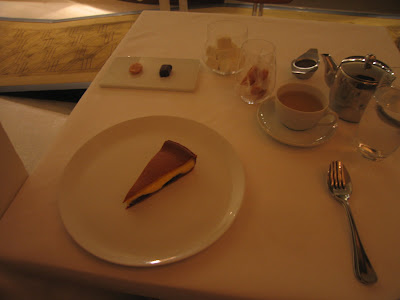
For my fourth and final course, I decided to treat myself to a dessert that Rockpool claimed as its creation since 1984, a slice of its date tart. The tart consists of a layer of dates lining the inside bottom of the tart, and soft custard above it to the brim. The surface had a thin brown crispy layer as though it was lightly torched. The custard itself was only mildly sweet, allowing the dates to play the chief role of providing flavour. The texture of the dates also allowed for a play of contrasts with both the tart crust and the custard. I wouldn't say that I found it as exceptionally memorable a dish as, say, the calamari with squid ink noodles, but that shouldn't be construed as my giving this dish a thumbs-down; this dessert was in fact quite enjoyable. I was also presented some petits-fours, of which I enjoyed the singular piece of dark choclate filled with cherry jelly. The passionfruit marshmallows were quite intriguing; totally unlike store-bought versions, these were soft, fluffy and mildly sweet without any synthetic undertones one can sense in store-bought marshmallows.
The Rocks has revealed a venue where one can have one's foodie urges satisfied and one's taste buds and eyes to be entertained. There are no dramatic view of the harbour from Rockpool, but the kitchen is open and best viewed from its Oyster Bar at the front of the restaurant; there's even a TV in the Oyster Bar, which is more of a relaxed bistro setting compared to the rest of Rockpool, that shows all the activity deeper in the kitchen. This place is definitely worth a visit, and the price for the dinner is worth it as well. And to top it all off for a wonderful evening, one can either stroll along Sydney Harbour or, like I did, take the Mosman Bay ferry and back to see the city light and the lit Opera House and Harbour Bridge.
Name: Rockpool
Address: 107 George St., The Rocks, NSW, Australia
Cuisine: Fusion (Mod Oz)
Price Range: Dinner AUS$120-AUS$195
Accessible: Yes
- A $120/person, 4-course tasting menu, which allowed for latitude in choice of dishes per course; and
- A $195/person, luxurious fixed 9-course tasting dinner.

The first of two canapes (aka amuses-bouche) was pureed zucchini in a crispy phyllo cup topped with Parmesan cream; yes, I was served more than one canape, a situation I'd not encountered beforehand but nonetheless gladly took and enjoyed. The first canape was light, the mild sweetness of the zucchini complemented by the savoury and slightly sour zing of the cream, and the soft mixtures contrasting with the delicately crispy phyllo.

The second canape offered to me was a goat cheese tortellini. This one tasted richer and more savoury than the zucchini phyllo, and though the flavouring was nice, my one criticism would be that it was not al dente, as I believe pasta should be. In this case, cooking it so that it still retains a firm bite should be more possible without any meat filling and the associated risk of undercooking the meat.

At last my first course arrived, an abalone and drunken chicken salad on fine noodles.The Chinese influence was evident in this dish with the drunken chicken and the bed of noodles. The use of fresh abalone, however, is less common in Chinese cuisine, but the Australians have taken advantage of using fresh versions plucked out of their own waters; fresh or dried, abalone is a pricey morsel of seafood. (Remember that $120 abalone "steak" I mentioned earlier?) The salad was light and clean, with the jelly beneath the very thin slice of lotus root countering the salad with a strong bang to it.

For my second course I chose the stir-fried southern calamari with back bacon, a pan-seared scallop and squid ink noodles. I'd heard of squid ink being used for cooking, though this isn't easily found everywhere as ink sacs are often removed when a squid is cleaned before packaging and/or consumption. It also stains very easily, turning the tender strips of calamari black, so a bib was offered by my server as a courteous precaution. Once again this dish had a Chinese flavour to it, and it was well prepared. As for the squid-ink noodles, they themselves had not strong, distinct flavour comparable to the stir-fried calamari, but it was a delicious take to naturally colouring noodles, something the Italians have best been known with its red, "white" and green pasta. The back bacon helped add some salt along with some firm texture to this dish.

The third course I had was crispy skin Murray cod with celeriac and olive purees and three variations of artichoke. The cod, exclusively a freshwater fish found only in Australia, was marinated and then cooked in two stages, the final one being searing the skin for the crispy finish. Two of the three ways in which the artichoke was prepared involved some form of pickling or vinegar-based dressing and included the stem and, of course, the heart. The third method involved frying the leaves to a light, golden crisp. The cod flaked easily but was still moist, a bit tricky to achieve as most seafood items can be ruined easily by overcooking.
As was the case of my course back at Number 8 in Melbourne, a side of vegetables and/or starch/carbohydrates was blatantly absent from my cod dish, and a few minutes after I was presented my main course I was given a small plate of mixed leaf salad. Without a second though I first finished my fish before tackling the salad, thinking that the Australians must've taken to heart a study I heard about years ago that it's actually healthier to eat your salad/vegetables after your main course instead of before it. Well, when I finished both items I got to talking with my server, and I quickly deduced that it's not as common for fine restaurants in Australia to have sides plated on a main course dish. I can appreciate my server's reluctance in possibly exposing my lack of knowledge about how things may be done differently in Australia, but I came to visit this country not only to see the sights but to learns as many aspect of Australian culture as I could in my short two-week visit here. Well, at least now I'll be a little wiser the next time I visit Australia.

For my fourth and final course, I decided to treat myself to a dessert that Rockpool claimed as its creation since 1984, a slice of its date tart. The tart consists of a layer of dates lining the inside bottom of the tart, and soft custard above it to the brim. The surface had a thin brown crispy layer as though it was lightly torched. The custard itself was only mildly sweet, allowing the dates to play the chief role of providing flavour. The texture of the dates also allowed for a play of contrasts with both the tart crust and the custard. I wouldn't say that I found it as exceptionally memorable a dish as, say, the calamari with squid ink noodles, but that shouldn't be construed as my giving this dish a thumbs-down; this dessert was in fact quite enjoyable. I was also presented some petits-fours, of which I enjoyed the singular piece of dark choclate filled with cherry jelly. The passionfruit marshmallows were quite intriguing; totally unlike store-bought versions, these were soft, fluffy and mildly sweet without any synthetic undertones one can sense in store-bought marshmallows.
The Rocks has revealed a venue where one can have one's foodie urges satisfied and one's taste buds and eyes to be entertained. There are no dramatic view of the harbour from Rockpool, but the kitchen is open and best viewed from its Oyster Bar at the front of the restaurant; there's even a TV in the Oyster Bar, which is more of a relaxed bistro setting compared to the rest of Rockpool, that shows all the activity deeper in the kitchen. This place is definitely worth a visit, and the price for the dinner is worth it as well. And to top it all off for a wonderful evening, one can either stroll along Sydney Harbour or, like I did, take the Mosman Bay ferry and back to see the city light and the lit Opera House and Harbour Bridge.
Name: Rockpool
Address: 107 George St., The Rocks, NSW, Australia
Cuisine: Fusion (Mod Oz)
Price Range: Dinner AUS$120-AUS$195
Accessible: Yes
Subscribe to:
Posts (Atom)


