While I was still in Australia back in May I was unable to try something that was uniquely Australian and started by that country thanks to a particular product made in that country and well-known amongst cookie lovers around the world. So, with that in mind, and with some Australian currency in need to be emptied from my pockets at Sydney International Airport, I stocked up on three (yes, three) packages of Tim Tams, of which one I gave to share with my department colleagues the day I returned for work. These cookies are quite unique in that the two biscuits used to sandwich the chocolate cream filling and together coated with chocolate are actually not entirely solid; the biscuits have a sort of micro-honeycomb structure allowing air or liquid to run through them. Thanks to that, the Tim Tam Slam was also invented, the practice of using the Tim Tam cookies as straws. Both ends are bitten off, one end is inserted into a liquid and voila, you have an edible straw.
Hot or cold liquids can be used. In my case tonight, I used cold milk. I'll admit I felt quite excited when I realized I could suck the milk through the cookie like a straw, and in a few seconds I could feel the cookie start to collapse as the biscuits started to soften from the milk. However, I managed to gobble up the cookies before they broke up any further, chewing virtually only on the chocolate as the biscuits had completely lost their volume and crunch. It was such a unique experience being a non-Australian, and I can see why Aussies have a special place in their hearts for Tim Tams and the Tim Tam Slam. (As for my colleagues, apparently none of them tried the Slam... most regrettably, their loss in my opinion.)
Next time I should perhaps try with hot milk and see if the chocolate cream in the middle melts as well. In that sense, I'm fortunate that I'll be having single-digit overnight temperatures this weekend in spite of being in the middle of summer. Unfortunately, I only have two boxes of Tim Tams from overseas; if anyone knows where I can buy these cookies in Canada (preferably Winnipeg, Toronto or Ottawa), I wouldn't mind stocking up on these beauties over the winter!
Friday, 10 July 2009

Saturday, 13 June 2009
An Evening at The Rocks to Remember
With Sydney being a cosmopolitan city like Melbourne, as well as perhaps the most popular international gateway into Australia, surely it should have its share of fine dining restaurants, as I'm sure the two cities don't like to be outdone by each other. Find a restaurant I did; in the midst of the historic neighbourhood of The Rocks was Rockpool, which is actually part of the Rockpool family of restaurants in Sydney (3) and Melbourne (1). (Coincidentally, Rockpool Bar and Grill in Melbourne's Southbank was one of the shortlist choices between me and my friend; I'll admit the AUS$140 20oz abalone "steak" was really tempting me.) Boasting of its sparticular use of fresh seafood in its evidently Mod Oz menu, and with only a day and a morning left before I had to fly back to Canada, I had to give this place a try. Checking the website at my hostel before deciding to go I discovered two menu options:

The first of two canapes (aka amuses-bouche) was pureed zucchini in a crispy phyllo cup topped with Parmesan cream; yes, I was served more than one canape, a situation I'd not encountered beforehand but nonetheless gladly took and enjoyed. The first canape was light, the mild sweetness of the zucchini complemented by the savoury and slightly sour zing of the cream, and the soft mixtures contrasting with the delicately crispy phyllo.

The second canape offered to me was a goat cheese tortellini. This one tasted richer and more savoury than the zucchini phyllo, and though the flavouring was nice, my one criticism would be that it was not al dente, as I believe pasta should be. In this case, cooking it so that it still retains a firm bite should be more possible without any meat filling and the associated risk of undercooking the meat.

At last my first course arrived, an abalone and drunken chicken salad on fine noodles.The Chinese influence was evident in this dish with the drunken chicken and the bed of noodles. The use of fresh abalone, however, is less common in Chinese cuisine, but the Australians have taken advantage of using fresh versions plucked out of their own waters; fresh or dried, abalone is a pricey morsel of seafood. (Remember that $120 abalone "steak" I mentioned earlier?) The salad was light and clean, with the jelly beneath the very thin slice of lotus root countering the salad with a strong bang to it.

For my second course I chose the stir-fried southern calamari with back bacon, a pan-seared scallop and squid ink noodles. I'd heard of squid ink being used for cooking, though this isn't easily found everywhere as ink sacs are often removed when a squid is cleaned before packaging and/or consumption. It also stains very easily, turning the tender strips of calamari black, so a bib was offered by my server as a courteous precaution. Once again this dish had a Chinese flavour to it, and it was well prepared. As for the squid-ink noodles, they themselves had not strong, distinct flavour comparable to the stir-fried calamari, but it was a delicious take to naturally colouring noodles, something the Italians have best been known with its red, "white" and green pasta. The back bacon helped add some salt along with some firm texture to this dish.

The third course I had was crispy skin Murray cod with celeriac and olive purees and three variations of artichoke. The cod, exclusively a freshwater fish found only in Australia, was marinated and then cooked in two stages, the final one being searing the skin for the crispy finish. Two of the three ways in which the artichoke was prepared involved some form of pickling or vinegar-based dressing and included the stem and, of course, the heart. The third method involved frying the leaves to a light, golden crisp. The cod flaked easily but was still moist, a bit tricky to achieve as most seafood items can be ruined easily by overcooking.
As was the case of my course back at Number 8 in Melbourne, a side of vegetables and/or starch/carbohydrates was blatantly absent from my cod dish, and a few minutes after I was presented my main course I was given a small plate of mixed leaf salad. Without a second though I first finished my fish before tackling the salad, thinking that the Australians must've taken to heart a study I heard about years ago that it's actually healthier to eat your salad/vegetables after your main course instead of before it. Well, when I finished both items I got to talking with my server, and I quickly deduced that it's not as common for fine restaurants in Australia to have sides plated on a main course dish. I can appreciate my server's reluctance in possibly exposing my lack of knowledge about how things may be done differently in Australia, but I came to visit this country not only to see the sights but to learns as many aspect of Australian culture as I could in my short two-week visit here. Well, at least now I'll be a little wiser the next time I visit Australia.
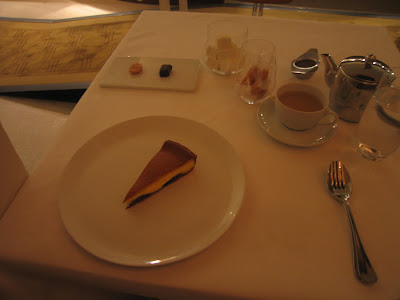
For my fourth and final course, I decided to treat myself to a dessert that Rockpool claimed as its creation since 1984, a slice of its date tart. The tart consists of a layer of dates lining the inside bottom of the tart, and soft custard above it to the brim. The surface had a thin brown crispy layer as though it was lightly torched. The custard itself was only mildly sweet, allowing the dates to play the chief role of providing flavour. The texture of the dates also allowed for a play of contrasts with both the tart crust and the custard. I wouldn't say that I found it as exceptionally memorable a dish as, say, the calamari with squid ink noodles, but that shouldn't be construed as my giving this dish a thumbs-down; this dessert was in fact quite enjoyable. I was also presented some petits-fours, of which I enjoyed the singular piece of dark choclate filled with cherry jelly. The passionfruit marshmallows were quite intriguing; totally unlike store-bought versions, these were soft, fluffy and mildly sweet without any synthetic undertones one can sense in store-bought marshmallows.
The Rocks has revealed a venue where one can have one's foodie urges satisfied and one's taste buds and eyes to be entertained. There are no dramatic view of the harbour from Rockpool, but the kitchen is open and best viewed from its Oyster Bar at the front of the restaurant; there's even a TV in the Oyster Bar, which is more of a relaxed bistro setting compared to the rest of Rockpool, that shows all the activity deeper in the kitchen. This place is definitely worth a visit, and the price for the dinner is worth it as well. And to top it all off for a wonderful evening, one can either stroll along Sydney Harbour or, like I did, take the Mosman Bay ferry and back to see the city light and the lit Opera House and Harbour Bridge.
Name: Rockpool
Address: 107 George St., The Rocks, NSW, Australia
Cuisine: Fusion (Mod Oz)
Price Range: Dinner AUS$120-AUS$195
Accessible: Yes
- A $120/person, 4-course tasting menu, which allowed for latitude in choice of dishes per course; and
- A $195/person, luxurious fixed 9-course tasting dinner.

The first of two canapes (aka amuses-bouche) was pureed zucchini in a crispy phyllo cup topped with Parmesan cream; yes, I was served more than one canape, a situation I'd not encountered beforehand but nonetheless gladly took and enjoyed. The first canape was light, the mild sweetness of the zucchini complemented by the savoury and slightly sour zing of the cream, and the soft mixtures contrasting with the delicately crispy phyllo.

The second canape offered to me was a goat cheese tortellini. This one tasted richer and more savoury than the zucchini phyllo, and though the flavouring was nice, my one criticism would be that it was not al dente, as I believe pasta should be. In this case, cooking it so that it still retains a firm bite should be more possible without any meat filling and the associated risk of undercooking the meat.

At last my first course arrived, an abalone and drunken chicken salad on fine noodles.The Chinese influence was evident in this dish with the drunken chicken and the bed of noodles. The use of fresh abalone, however, is less common in Chinese cuisine, but the Australians have taken advantage of using fresh versions plucked out of their own waters; fresh or dried, abalone is a pricey morsel of seafood. (Remember that $120 abalone "steak" I mentioned earlier?) The salad was light and clean, with the jelly beneath the very thin slice of lotus root countering the salad with a strong bang to it.

For my second course I chose the stir-fried southern calamari with back bacon, a pan-seared scallop and squid ink noodles. I'd heard of squid ink being used for cooking, though this isn't easily found everywhere as ink sacs are often removed when a squid is cleaned before packaging and/or consumption. It also stains very easily, turning the tender strips of calamari black, so a bib was offered by my server as a courteous precaution. Once again this dish had a Chinese flavour to it, and it was well prepared. As for the squid-ink noodles, they themselves had not strong, distinct flavour comparable to the stir-fried calamari, but it was a delicious take to naturally colouring noodles, something the Italians have best been known with its red, "white" and green pasta. The back bacon helped add some salt along with some firm texture to this dish.

The third course I had was crispy skin Murray cod with celeriac and olive purees and three variations of artichoke. The cod, exclusively a freshwater fish found only in Australia, was marinated and then cooked in two stages, the final one being searing the skin for the crispy finish. Two of the three ways in which the artichoke was prepared involved some form of pickling or vinegar-based dressing and included the stem and, of course, the heart. The third method involved frying the leaves to a light, golden crisp. The cod flaked easily but was still moist, a bit tricky to achieve as most seafood items can be ruined easily by overcooking.
As was the case of my course back at Number 8 in Melbourne, a side of vegetables and/or starch/carbohydrates was blatantly absent from my cod dish, and a few minutes after I was presented my main course I was given a small plate of mixed leaf salad. Without a second though I first finished my fish before tackling the salad, thinking that the Australians must've taken to heart a study I heard about years ago that it's actually healthier to eat your salad/vegetables after your main course instead of before it. Well, when I finished both items I got to talking with my server, and I quickly deduced that it's not as common for fine restaurants in Australia to have sides plated on a main course dish. I can appreciate my server's reluctance in possibly exposing my lack of knowledge about how things may be done differently in Australia, but I came to visit this country not only to see the sights but to learns as many aspect of Australian culture as I could in my short two-week visit here. Well, at least now I'll be a little wiser the next time I visit Australia.

For my fourth and final course, I decided to treat myself to a dessert that Rockpool claimed as its creation since 1984, a slice of its date tart. The tart consists of a layer of dates lining the inside bottom of the tart, and soft custard above it to the brim. The surface had a thin brown crispy layer as though it was lightly torched. The custard itself was only mildly sweet, allowing the dates to play the chief role of providing flavour. The texture of the dates also allowed for a play of contrasts with both the tart crust and the custard. I wouldn't say that I found it as exceptionally memorable a dish as, say, the calamari with squid ink noodles, but that shouldn't be construed as my giving this dish a thumbs-down; this dessert was in fact quite enjoyable. I was also presented some petits-fours, of which I enjoyed the singular piece of dark choclate filled with cherry jelly. The passionfruit marshmallows were quite intriguing; totally unlike store-bought versions, these were soft, fluffy and mildly sweet without any synthetic undertones one can sense in store-bought marshmallows.
The Rocks has revealed a venue where one can have one's foodie urges satisfied and one's taste buds and eyes to be entertained. There are no dramatic view of the harbour from Rockpool, but the kitchen is open and best viewed from its Oyster Bar at the front of the restaurant; there's even a TV in the Oyster Bar, which is more of a relaxed bistro setting compared to the rest of Rockpool, that shows all the activity deeper in the kitchen. This place is definitely worth a visit, and the price for the dinner is worth it as well. And to top it all off for a wonderful evening, one can either stroll along Sydney Harbour or, like I did, take the Mosman Bay ferry and back to see the city light and the lit Opera House and Harbour Bridge.
Name: Rockpool
Address: 107 George St., The Rocks, NSW, Australia
Cuisine: Fusion (Mod Oz)
Price Range: Dinner AUS$120-AUS$195
Accessible: Yes
Thursday, 11 June 2009
A Solid Return on a Gamble
Before travelling to Australia, I've heard that Melbourne is a foodie haven, and having sensed how cosmopolitan the city is in my travels around town, I could see and therefore hoped to experience a pleasant dinner that helps Melbourne live up to this reputation. Having finished watching a footy (Aussie rules football) game at the Melbourne Cricket Ground east of downtown, my friend and I gravitated ourselves towards Southbank were there were plenty of restaurants and eateries along the Yarra River. After scouting a bit we created a shortlist of three restaurants, and after meeting with my friend's boyfriend and a friend of theirs, we decided to go for the one called Number 8, one of several restaurants found in the Crown Casino and Entertainment Complex. A few presumptions were made to ultimately help us choose this particular place:

After that delightful amuse-bouche I had my entree, wagyu beef carpaccio with pecorino and rocket (arugula). Apparently Australia now also produces a good amount of this type of beef, made famous in Japan for its exquisitely marbled meat and, in Japan at least, for the cattle being fed beer (i.e. Kobe beef). Carpaccio, often using red meat (though tuna can also be used as well) is essentially the red meat equivalent to sashimi, so the beef used has to be very fresh and handled carefully. The dish was surprisingly light, and the rocket and pecorino complemented well, providing a good balance of flavours.

For my main course I had something that I've yet to see in Canada and likely never will, Moreton Bay bugs. Found on the northern shores of Australia as well as parts of Southeast Asia, the bug is actually a type of lobster famed for its fleshy tail that's larger than a tiger prawn's but smaller than an homard lobster's. Served simply grilled with a touch of salt, pepper and a garnish of fresh herbs and sprouts, the meat was a wonderful treat with a sweet undertone that's unlike homard lobster. Curiously enough, in Australia vegetables aren't always served on a main course dish unlike in North American restaurants, as I learned for sure when I later dined at another wonderful restaurant in Sydney; sides of vegetables were ordered in our case here to share.

Lastly, for dessert I had a leatherwood honey panacotta, made with honey of a tree found only in Tasmania. It certainly had a subtly different taste than the ones to which I'm accustomed in Canada, but I for the life of me can't lay a finger on terms to describe it. It tastes slightly heavier than spring honey, but definitely lighter than blueberry flowers honey. Nonetheless, served with a rhubarb compote it was light and had the right sweetness, a perfect ending to my dinner outside as the casino's riverside giant torches rang in the second hour we dined there.
My friend and I rolled the dice in choosing a place in a casino for dinner, and in the end it appeared like we picked a winner. If you ever get yourself in Melbourne, be sure to make a stop at Number 8 if you can only try one nice restaurant; your taste buds will agree it'll have been worth the long journey. This place is worth the hit on the wallet, though most of the time dinner shouldn't require more than $100 (excluding drinks); the only case where you'll have to pay more than $100/person is if you share with someone a Seafood Journey for 2 and have an entree and desert as well.
Name: Number 8 Restaurant & Wine Bar
Address: Riverside at Crown Casino, Southbank, VIC, Australia
Cuisine: Fusion (Mod Oz)
Price Range: Lunch AUS$55-AUS$70; Dinner AUS$65-AUS$150
Accessible: Yes (except washrooms)
- It had to have fresh oysters available (we were absolutely craving for oysters);
- It had to showcase some of the finest cuisine and delights that Melbourne (and Australia in general) had to offer; and
- It had to be a fairly short distance from my friend's boyfriend's conference venue, as he was temporarily on crutches.

After that delightful amuse-bouche I had my entree, wagyu beef carpaccio with pecorino and rocket (arugula). Apparently Australia now also produces a good amount of this type of beef, made famous in Japan for its exquisitely marbled meat and, in Japan at least, for the cattle being fed beer (i.e. Kobe beef). Carpaccio, often using red meat (though tuna can also be used as well) is essentially the red meat equivalent to sashimi, so the beef used has to be very fresh and handled carefully. The dish was surprisingly light, and the rocket and pecorino complemented well, providing a good balance of flavours.

For my main course I had something that I've yet to see in Canada and likely never will, Moreton Bay bugs. Found on the northern shores of Australia as well as parts of Southeast Asia, the bug is actually a type of lobster famed for its fleshy tail that's larger than a tiger prawn's but smaller than an homard lobster's. Served simply grilled with a touch of salt, pepper and a garnish of fresh herbs and sprouts, the meat was a wonderful treat with a sweet undertone that's unlike homard lobster. Curiously enough, in Australia vegetables aren't always served on a main course dish unlike in North American restaurants, as I learned for sure when I later dined at another wonderful restaurant in Sydney; sides of vegetables were ordered in our case here to share.

Lastly, for dessert I had a leatherwood honey panacotta, made with honey of a tree found only in Tasmania. It certainly had a subtly different taste than the ones to which I'm accustomed in Canada, but I for the life of me can't lay a finger on terms to describe it. It tastes slightly heavier than spring honey, but definitely lighter than blueberry flowers honey. Nonetheless, served with a rhubarb compote it was light and had the right sweetness, a perfect ending to my dinner outside as the casino's riverside giant torches rang in the second hour we dined there.
My friend and I rolled the dice in choosing a place in a casino for dinner, and in the end it appeared like we picked a winner. If you ever get yourself in Melbourne, be sure to make a stop at Number 8 if you can only try one nice restaurant; your taste buds will agree it'll have been worth the long journey. This place is worth the hit on the wallet, though most of the time dinner shouldn't require more than $100 (excluding drinks); the only case where you'll have to pay more than $100/person is if you share with someone a Seafood Journey for 2 and have an entree and desert as well.
Name: Number 8 Restaurant & Wine Bar
Address: Riverside at Crown Casino, Southbank, VIC, Australia
Cuisine: Fusion (Mod Oz)
Price Range: Lunch AUS$55-AUS$70; Dinner AUS$65-AUS$150
Accessible: Yes (except washrooms)
Wednesday, 10 June 2009
My First Taste of Australia
Now don't bring out those steak knives, I can easily explain my absence from this blog once again! I was travelling in Australia for two weeks in May, so I kept myself low in April as I prepared for that vacation, and ever since my return I'd been tidying things up elsewhere, such as my personal blog, before I could finally update this blog. Fortunately, there have been instances from my Australia trip that require entries on this food blog, and so you'll see two more entries related to this trip. This, therefore, is the first of three entries, all restaurant reviews. If any of these entries attracts Aussie readers, welcome, and thank you for the wonderful Aussie hospitality!
Cairns, Australia is a veritable tourist town, and you may recall how I feel about dining in tourist areas. So, coming to this city I was prepared to make do with some unglamourous meals until I walked past an eatery near my hostel, Ochre Restaurant, which featured Modern Australian, or Mod Oz, cuisine. Mod Oz is basically the Australian way of calling fusion cuisine, and Ochre's menu definitely fit this category. Wanting to try things that are unique and/or special to Australia, I opted to try the Game Platter which when I ordered featured two dishes.

The first course, essentially the appetizer, definitely screamed Oriental influences. Featuring crocodile, it was cooked "salt and pepper" style, not unlike the salt and pepper ribs or prawns found in some Chinese restaurants, and served with Vietnamese-style pickled vegetables and some lemon aspen sambal (the sauce in the spoon). The flavouring was just right, and the crocodile especially was, thankfully, not too heavy on salt, a characteristic I'd experienced too often at some restaurants that do salt and pepper style meat dishes. My impression of crocodile meat is that it's as mild in flavour as chicken, though it has that watery undertone that one would notice when eating perfectly cooked white fish, but it is slightly tougher than chicken in texture. The vegetables provided a nice sour counterweight to the mildly greasy crocodile pieces that was sprinkled with pepper particularly native to Australia. I honestly can't say I could taste any difference between Australian pepper and pepper from other parts in the world, but this dish, from the pepper to the crocodile to the use of lemon aspen fruit, gave me an idea of how strongly this restaurant emphasized on using as many domestic if not local ingredients as possible.

The second (main) course featured two other animals native to Australia: kangaroo and emu. (Later on during this trip I learned that both animals are on the country's coat of arms, and Australia is the only country in the world whose coat of arms features animals eaten by humans.) Now, before some of you rail at me for eating an animal that's been idolized in Bugs Bunny cartoons, as an unofficial ambassador for Australia and even as the logo for Qantas, I must forward some trivia I learned about kangaroos. They to Australians are like what Canada geese are to Canadians. Both are symbols of their respective countries, yet both have become overpopulated, becoming grazing/foraging pests and vermin. If there are no qualms to eating geese (Canada or not), why fuss over a few kangaroos?
The grilled emu (left), cooked no more than medium, was a bit tougher than I thought it would be, but the flavour was nice, enhanced thanks to its reduction with mushrooms and topped with sliver-thin slices of pancetta. The grilled kangaroo, though, really caught my eyes and taste buds. Tender and cooked medium-rare, it was enhanced with a chili quandong glaze (pronounced with a silent "u") with halved (desert or sweet) quandongs, small, wild peaches, scattered about. The two types of meat were accompanied by some steamed bok choy, sweet potato fritter (julienned sweet potato in tempura batter) and, off-side, a sweet-potato and spinach gratin. I wasn't that crazy about the gratin, but it didn't dampen my enthusiasm for the kangaroo one bit.
Ochre gave me my first glimpse into both Mod Oz cuisine as well as Australian game and some unique ingredients, and did so quite satisfactorily. Though I now definitely expect higher standards when I reach Melbourne and return briefly to Sydney and try some of the fine dining joints there, this visit in Cairns turned out to be a promising start.
Name: Ochre Restaurant
Address: 43 Shields St., Cairns, QLD, Australia
Cuisine: Fusion (Mod Oz)
Price Range: Lunch AUS$20-AUS$50; Dinner AUS$60-AUS$80
Accessible: Yes
Cairns, Australia is a veritable tourist town, and you may recall how I feel about dining in tourist areas. So, coming to this city I was prepared to make do with some unglamourous meals until I walked past an eatery near my hostel, Ochre Restaurant, which featured Modern Australian, or Mod Oz, cuisine. Mod Oz is basically the Australian way of calling fusion cuisine, and Ochre's menu definitely fit this category. Wanting to try things that are unique and/or special to Australia, I opted to try the Game Platter which when I ordered featured two dishes.

The first course, essentially the appetizer, definitely screamed Oriental influences. Featuring crocodile, it was cooked "salt and pepper" style, not unlike the salt and pepper ribs or prawns found in some Chinese restaurants, and served with Vietnamese-style pickled vegetables and some lemon aspen sambal (the sauce in the spoon). The flavouring was just right, and the crocodile especially was, thankfully, not too heavy on salt, a characteristic I'd experienced too often at some restaurants that do salt and pepper style meat dishes. My impression of crocodile meat is that it's as mild in flavour as chicken, though it has that watery undertone that one would notice when eating perfectly cooked white fish, but it is slightly tougher than chicken in texture. The vegetables provided a nice sour counterweight to the mildly greasy crocodile pieces that was sprinkled with pepper particularly native to Australia. I honestly can't say I could taste any difference between Australian pepper and pepper from other parts in the world, but this dish, from the pepper to the crocodile to the use of lemon aspen fruit, gave me an idea of how strongly this restaurant emphasized on using as many domestic if not local ingredients as possible.

The second (main) course featured two other animals native to Australia: kangaroo and emu. (Later on during this trip I learned that both animals are on the country's coat of arms, and Australia is the only country in the world whose coat of arms features animals eaten by humans.) Now, before some of you rail at me for eating an animal that's been idolized in Bugs Bunny cartoons, as an unofficial ambassador for Australia and even as the logo for Qantas, I must forward some trivia I learned about kangaroos. They to Australians are like what Canada geese are to Canadians. Both are symbols of their respective countries, yet both have become overpopulated, becoming grazing/foraging pests and vermin. If there are no qualms to eating geese (Canada or not), why fuss over a few kangaroos?
The grilled emu (left), cooked no more than medium, was a bit tougher than I thought it would be, but the flavour was nice, enhanced thanks to its reduction with mushrooms and topped with sliver-thin slices of pancetta. The grilled kangaroo, though, really caught my eyes and taste buds. Tender and cooked medium-rare, it was enhanced with a chili quandong glaze (pronounced with a silent "u") with halved (desert or sweet) quandongs, small, wild peaches, scattered about. The two types of meat were accompanied by some steamed bok choy, sweet potato fritter (julienned sweet potato in tempura batter) and, off-side, a sweet-potato and spinach gratin. I wasn't that crazy about the gratin, but it didn't dampen my enthusiasm for the kangaroo one bit.
Ochre gave me my first glimpse into both Mod Oz cuisine as well as Australian game and some unique ingredients, and did so quite satisfactorily. Though I now definitely expect higher standards when I reach Melbourne and return briefly to Sydney and try some of the fine dining joints there, this visit in Cairns turned out to be a promising start.
Name: Ochre Restaurant
Address: 43 Shields St., Cairns, QLD, Australia
Cuisine: Fusion (Mod Oz)
Price Range: Lunch AUS$20-AUS$50; Dinner AUS$60-AUS$80
Accessible: Yes
Thursday, 12 March 2009
Bringing Bacon to Work
Dishes where meats and fruits comingle abound such as Hawaiian-style pizza, sweet and sour pork and lemon chicken. Personally, though, I'd never been a big fan of sweet (and sour) mixed with savoury until I was exposed to a couple of Italian examples, the most classic one being Proscuitto con melone, where slices of specially cured ham are wrapped around melon balls. One particularly impressive variation to the Italian theme on which I got to indulge was when I was in Ottawa last November. Between the actual ceremony and dinner at a childhood friend's wedding there was some finger food served, one of which I absolutely loved. It consisted of slices of pancetta fried to a crisp, topped with a slice of pear held in place vertically by a dab of goat cheese. I absolutely couldn't get enough of it, I'll confess!
Roll the timeline to this week. Yesterday my office had another potluck lunch, and when we first agreed to have one, my first concrete thought of a dish to make was the pancetta-pear delight. Of course, I realized using pancetta wasn't worth it in this case for a few reasons:
Food purists can give a hue and cry all they want, but let's face it, pancetta, when broken down to its basic components, is fancy pork belly. Bacon, perchance, is also pork belly. Pork is a popular meat in marrying with fruit, so I figured, why not attempt to use bacon for my own concoction?
Still on the subject of substitution, I decided to substitute goat cheese with cream cheese. Again, price and general appreciativeness by my colleagues were key factors, though this time I decided to get some flavoured cream cheese, in this case herb and garlic, to give some added dimension. I'm not ashamed to have made such substitutions, and the fact that everyone, yes, everyone, in my office who was there enjoyed my dish should stand as testament to at least my cooking competence. Food is made to be enjoyed, and if others enjoy it, then I will have been successful.


And here are pictures of the end product! As you can see, I solved the problem of bacon being much longer then pear slices by cutting the bacon (I used the reduced salt version in this case) in half before frying the slices to a crisp over medium heat in my trusty cast iron pan and letting them cool on paper towels that also absorbed the extra grease. Unfortunately some of the slices broke laterally in two due to already weak connections in a layer of fat in this batch of bacon, so I salvaged the bacon by using the larger, intact pieces as the base with the split pieces placed on top of the pear slices. All the bacon and pear slices (about 2-3mm thick) are held in place with dabs of the cream cheese.
I started frying the bacon at ~5:30am so that I could complete this dish in time for breakfast and work, so that meant it wouldn't be eaten for at least 6.5 hours. Frying the bacon to a true crisp (without burning them) is therefore key to the success of this dish. Even after that many hours stored in a cool place to keep the cream cheese safe the bacon will still retain quite a bit of crispiness, though you wouldn't be able to hear someone chomping on these bacon-pear bites from across the room compared to when they were made fresh. Still, neither the saltiness of the bacon nor the sweetness of the pear were overpowering, and the cream cheese added just a subtle zing to it all.
I didn't bring home any leftovers, so I say it was well worth waking up earlier than usual to make this dish for my colleague to enjoy.
Roll the timeline to this week. Yesterday my office had another potluck lunch, and when we first agreed to have one, my first concrete thought of a dish to make was the pancetta-pear delight. Of course, I realized using pancetta wasn't worth it in this case for a few reasons:
- This wasn't a cocktail party, it was just a nice social gathering amongst colleagues; there was no need for me to go overboard;
- Pancetta is more of a luxury (i.e. $$$), I wasn't certain I could get some in Brandon and I wasn't planning to do a shopping run in Winnipeg anytime soon; and
- Most of my colleagues are not foodies per se and, as one of them pointed out to me, may not fully appreciate the more luxuriant dishes.
Food purists can give a hue and cry all they want, but let's face it, pancetta, when broken down to its basic components, is fancy pork belly. Bacon, perchance, is also pork belly. Pork is a popular meat in marrying with fruit, so I figured, why not attempt to use bacon for my own concoction?
Still on the subject of substitution, I decided to substitute goat cheese with cream cheese. Again, price and general appreciativeness by my colleagues were key factors, though this time I decided to get some flavoured cream cheese, in this case herb and garlic, to give some added dimension. I'm not ashamed to have made such substitutions, and the fact that everyone, yes, everyone, in my office who was there enjoyed my dish should stand as testament to at least my cooking competence. Food is made to be enjoyed, and if others enjoy it, then I will have been successful.


And here are pictures of the end product! As you can see, I solved the problem of bacon being much longer then pear slices by cutting the bacon (I used the reduced salt version in this case) in half before frying the slices to a crisp over medium heat in my trusty cast iron pan and letting them cool on paper towels that also absorbed the extra grease. Unfortunately some of the slices broke laterally in two due to already weak connections in a layer of fat in this batch of bacon, so I salvaged the bacon by using the larger, intact pieces as the base with the split pieces placed on top of the pear slices. All the bacon and pear slices (about 2-3mm thick) are held in place with dabs of the cream cheese.
I started frying the bacon at ~5:30am so that I could complete this dish in time for breakfast and work, so that meant it wouldn't be eaten for at least 6.5 hours. Frying the bacon to a true crisp (without burning them) is therefore key to the success of this dish. Even after that many hours stored in a cool place to keep the cream cheese safe the bacon will still retain quite a bit of crispiness, though you wouldn't be able to hear someone chomping on these bacon-pear bites from across the room compared to when they were made fresh. Still, neither the saltiness of the bacon nor the sweetness of the pear were overpowering, and the cream cheese added just a subtle zing to it all.
I didn't bring home any leftovers, so I say it was well worth waking up earlier than usual to make this dish for my colleague to enjoy.
Saturday, 28 February 2009
Gästhaus' Looks Belie Dining Experience
I must first apologize for seemingly to have neglected my food blog. Unfortunately, until the last weekend I hadn't been to a new restaurant for dinner of which to write a review, and I hadn't been inspired to try to concoct a new dish at home. However, I was in Winnipeg last Saturday, and that gave me the opportunity to try a place in which I hadn't dined before.
German cuisine is arguably not as refined in general as some of the other cuisines in the world; it tends to have a heartier, down-to-earth edge to it. Though higher-end fine dining can be very enjoyable experiences, often the cravings for something slightly lower on the hierarchy of cuisine (i.e. fine dining at the top, fast food at the bottom) come up, sometimes resulting in rewarding experiences as well. Gästhaus Gutenberger, a German restaurant in the western suburbs of Winnipeg, should make this list.
This place was recommended to me by a friend of a friend of mine who perchance has some German heritage. At the risk of sounding discriminatory, I believe that the best (or worst) food critics are those who share and know very well the same culture and/or ethnicity. This is likely because we would know our own culture or ethnic heritage best, and therefore we'd be better able to differentiate the authentic restaurants from the pretenders. So, with a friendly suggestion in hand, I made my way to try this place for dinner.
When you enter the restaurant you feel like you may have just walked through a time warp. The interior decor is evidently aged. I don't just simply mean making it look old to give it a visual touch to a German restaurant, but the interior design seemed to have been unchanged for years. Some of the railings, light fixtures and even a bit of the ceiling unfortunately showed some wear and tear as well. Where the restaurant has its weaknesses physically, it was compensated, however, by a decent dining experience thanks to a mix of service, food and surprisingly even entertainment with an accordionist occasionally strumming some tunes throughout the restaurant.
At my server's suggestion I just ordered a main course, which itself included either a soup of the day or a salad. I opted for the soup, which that night was beef and barley, which perchance had in it (surprise, surprise!) cabbage and was justd a touch on the underflavoured side. For the main course I decided to try the Schweizer Rahm Schnitzel, which was a schnitzel topped with a slice of Black Forest ham, mushrooms and a white wine cream sauce with spätzle and red cabbage. The ham added another layer of flavour to the dish but was also effective in preventing the sauce and mushrooms from making the schnitzel lose its breaded cripiness. The server's suggestion was well founded, as I found myself quite full after finishing this dish.
Gästhaus Gutenberger is a good place to just sit back, relax and enjoy some real hearty food in a cosy, if aged, setting. It could give itself a facelift just enough to make it look fresh without losing the atmosphere. Reservations are recommended as this place gets quite busy for dinner. Also, for the more adventurous, pork hocks are served here as well, but on weekends only apparently.
Name: Gästhaus Gutenberger
Address: 2583 Portage Ave., Winnipeg, MB
Cuisine: German
Price Range: Dinner Entrées $20-$37
Accessible: Yes
German cuisine is arguably not as refined in general as some of the other cuisines in the world; it tends to have a heartier, down-to-earth edge to it. Though higher-end fine dining can be very enjoyable experiences, often the cravings for something slightly lower on the hierarchy of cuisine (i.e. fine dining at the top, fast food at the bottom) come up, sometimes resulting in rewarding experiences as well. Gästhaus Gutenberger, a German restaurant in the western suburbs of Winnipeg, should make this list.
This place was recommended to me by a friend of a friend of mine who perchance has some German heritage. At the risk of sounding discriminatory, I believe that the best (or worst) food critics are those who share and know very well the same culture and/or ethnicity. This is likely because we would know our own culture or ethnic heritage best, and therefore we'd be better able to differentiate the authentic restaurants from the pretenders. So, with a friendly suggestion in hand, I made my way to try this place for dinner.
When you enter the restaurant you feel like you may have just walked through a time warp. The interior decor is evidently aged. I don't just simply mean making it look old to give it a visual touch to a German restaurant, but the interior design seemed to have been unchanged for years. Some of the railings, light fixtures and even a bit of the ceiling unfortunately showed some wear and tear as well. Where the restaurant has its weaknesses physically, it was compensated, however, by a decent dining experience thanks to a mix of service, food and surprisingly even entertainment with an accordionist occasionally strumming some tunes throughout the restaurant.
At my server's suggestion I just ordered a main course, which itself included either a soup of the day or a salad. I opted for the soup, which that night was beef and barley, which perchance had in it (surprise, surprise!) cabbage and was justd a touch on the underflavoured side. For the main course I decided to try the Schweizer Rahm Schnitzel, which was a schnitzel topped with a slice of Black Forest ham, mushrooms and a white wine cream sauce with spätzle and red cabbage. The ham added another layer of flavour to the dish but was also effective in preventing the sauce and mushrooms from making the schnitzel lose its breaded cripiness. The server's suggestion was well founded, as I found myself quite full after finishing this dish.
Gästhaus Gutenberger is a good place to just sit back, relax and enjoy some real hearty food in a cosy, if aged, setting. It could give itself a facelift just enough to make it look fresh without losing the atmosphere. Reservations are recommended as this place gets quite busy for dinner. Also, for the more adventurous, pork hocks are served here as well, but on weekends only apparently.
Name: Gästhaus Gutenberger
Address: 2583 Portage Ave., Winnipeg, MB
Cuisine: German
Price Range: Dinner Entrées $20-$37
Accessible: Yes
Thursday, 4 December 2008
A Spirit of Iron Chef Moment
On my last evening in Toronton during my November trip my family and I went to Canoe for dinner. Canoe is one of several restaurants run by Oliver and Bonacini, which perchance also owns the SOMA Chocolatier found in the Distillery district. As my sister pointed out in her Summerlicious blog entry, this restaurant was definitely worth the visit. Unfortunately it was too dark for me to take pictures without the flashbulg, and the flash would have been distracting to nearby diners. So, although there's no eye candy for you to see here, I must take a moment to share what I'd call my own "Iron Chef" moment.
Ah... "Iron Chef". "If memory serves me right..." it was arguably my favourite show on the Food Network while it still was on the Food Network. For those of you not familiar, the show's host had 3-4 chefs who were arguably the best in their cuisines (Japanese, French, Chinese, and later on Italian) in Japan who would compete against a challenging chef in Kitchen Stadium. Each epsiode a different challenger comes forth and both opponents must cook dishes with a theme ingredient of the day. Creativity and thinking (or cooking) outside the box has typically been seen favourably by most of the guest judges on that show, and sometimes the theme ingredients themselves require chefs to be super-creative in their cooking; ever thought of using foie gras in creating Japanese dishes?
Now that I've described the show in a nutshell, I must now explain why I felt I experienced an "Iron Chef Moment" as I'll call it. More specifically, I felt like I could've been in a guest judge's position (or perhaps I could be as wacky as Chairman Kaga, who knows?) when I had my dessert at Canoe. That night, I'd tried arguably the most avant-garde dessert I've ever had to date in my 20-something years of life: foie gras tart.
Yes, you read that right, foie gras tart... a dessert tart where the main ingredient is duck liver. Now, duck ethics aside, to an average person the thought of using foie gras, a savoury ingredient, as a dessert item seems unconscionable or outrageous. Of course, I was surprised and admittedly quite amused, so I asked the waiter about it. After the explanation, including the reassurance that the foie gras itself would be mild in taste, curiosity got the best of me and I decided to try it. Besides, with something as unique as this, how often could I experience such dishes?
Topped with cherries, the foie gras tart didn't taste like what I'd expected it to be. The flavour of the foie gras itself was subdued, and it was generally sweet. The slight saltiness of the foie gras, along with the soft, melt-in-your-mouth texture, was actually to me more reminiscent of a saltier version of a cheesecake. It definitely tasted richer than a cheesecake, and surprisingly the flavourings got along well.
In the end, what's my verdict about it? Well, first of all, full marks for creativity. There's no doubt about it that this was rather an unusual presentation of foie gras, yet this ingredient was used successfully in an audaciously unorthodox manner. As for taste, I'd give it high (but not full) marks. Again, the flavours went well with each other in the tart, and I'll admit that another mental barrier about food has been broken, but it was a tad bit saltier than I perhaps would've liked in a dessert. Furthermore, I think health concerns have now gotten the best of me. Foie gras literally is translated from French as "fat liver", and trust me, even you'd only want to consume them sparingly. It is more because of that that I find it hard to see myself trying it anytime soon, and it doesn't help that I managed to gain two pounds in two weeks' time by the end of this trip (that's way faster than the "Frosh 15" rate).
Though I may not touch foie gras in a while, I trust that I can try something new and/or unique again soon; creativity in this world, be it in food, the arts or any other field, needs to be continuously explored. Let this also be a lesson to you out there. There's no way for sure that you'll like or dislike something until you try it. Sometimes it takes a bit of guts (pardon the pun here) to jump that mental barrier, but sometimes there can be surprising rewards in the end.
Ah... "Iron Chef". "If memory serves me right..." it was arguably my favourite show on the Food Network while it still was on the Food Network. For those of you not familiar, the show's host had 3-4 chefs who were arguably the best in their cuisines (Japanese, French, Chinese, and later on Italian) in Japan who would compete against a challenging chef in Kitchen Stadium. Each epsiode a different challenger comes forth and both opponents must cook dishes with a theme ingredient of the day. Creativity and thinking (or cooking) outside the box has typically been seen favourably by most of the guest judges on that show, and sometimes the theme ingredients themselves require chefs to be super-creative in their cooking; ever thought of using foie gras in creating Japanese dishes?
Now that I've described the show in a nutshell, I must now explain why I felt I experienced an "Iron Chef Moment" as I'll call it. More specifically, I felt like I could've been in a guest judge's position (or perhaps I could be as wacky as Chairman Kaga, who knows?) when I had my dessert at Canoe. That night, I'd tried arguably the most avant-garde dessert I've ever had to date in my 20-something years of life: foie gras tart.
Yes, you read that right, foie gras tart... a dessert tart where the main ingredient is duck liver. Now, duck ethics aside, to an average person the thought of using foie gras, a savoury ingredient, as a dessert item seems unconscionable or outrageous. Of course, I was surprised and admittedly quite amused, so I asked the waiter about it. After the explanation, including the reassurance that the foie gras itself would be mild in taste, curiosity got the best of me and I decided to try it. Besides, with something as unique as this, how often could I experience such dishes?
Topped with cherries, the foie gras tart didn't taste like what I'd expected it to be. The flavour of the foie gras itself was subdued, and it was generally sweet. The slight saltiness of the foie gras, along with the soft, melt-in-your-mouth texture, was actually to me more reminiscent of a saltier version of a cheesecake. It definitely tasted richer than a cheesecake, and surprisingly the flavourings got along well.
In the end, what's my verdict about it? Well, first of all, full marks for creativity. There's no doubt about it that this was rather an unusual presentation of foie gras, yet this ingredient was used successfully in an audaciously unorthodox manner. As for taste, I'd give it high (but not full) marks. Again, the flavours went well with each other in the tart, and I'll admit that another mental barrier about food has been broken, but it was a tad bit saltier than I perhaps would've liked in a dessert. Furthermore, I think health concerns have now gotten the best of me. Foie gras literally is translated from French as "fat liver", and trust me, even you'd only want to consume them sparingly. It is more because of that that I find it hard to see myself trying it anytime soon, and it doesn't help that I managed to gain two pounds in two weeks' time by the end of this trip (that's way faster than the "Frosh 15" rate).
Though I may not touch foie gras in a while, I trust that I can try something new and/or unique again soon; creativity in this world, be it in food, the arts or any other field, needs to be continuously explored. Let this also be a lesson to you out there. There's no way for sure that you'll like or dislike something until you try it. Sometimes it takes a bit of guts (pardon the pun here) to jump that mental barrier, but sometimes there can be surprising rewards in the end.
Sunday, 30 November 2008
A Mercurial Ending to a Good Day
My Tuesday in Toronto was a good one, starting off with lunch with a university buddy at diner called Fran's Restaurant, going to a live taping of CBC's The Hour with my sister, and ending the night with a dinner with her at Bar Mercurio, an Italian restaurant previously discovered by my sister, as explained in her review in her food blog (you'll notice we both have the same pictures, as my camera was used). Located on Bloor Street West just west of the St. George subway station it's in the midst of the University of Toronto (according to my sister, it's actually in UofT's English building) and in close proximity to the ROM and Queen's Park. I'll admit we really wanted to try Nota Bene first that evening, but we couldn't get a table for the time we wanted there; considering En Route ranked it the best new restaurant in Canada this year, I'm looking forward to my next return to Toronto to try this joint.
Two things I noticed right away when I entered Bar Mercurio were the following: first, it was a small, packed house, and second, there was an open kitchen further up the bar counter, allowing the aromas of the dishes being prepared to permeate and mingle in the air with the babble of various conversations amongst diners. One thing I began to feel a bit disappointed about after we sat at our table was the wait for service at times. Perhaps since we were in a small corner of the restaurant away from where most of the tables are we weren't attended as quick as I expected, especially when it came to the serving of our dishes. That gave us some more time though at least to enjoy the bread basket offered to us. The focaccia was chewier than what I expected (and especially chewier than my sister's version), but the tuscan bean dip was a nice touch, a departure from butter or even the more stereotyipcally Italian oilve oil/balsamic vinegar dip. As I chewed I also noticed how this place covers the linen tablecloths with large sheets of paper; if the paper can actually keep the tablecloths clean, I don't know which has the more detrimental environmental effect, the constant use and replace of the paper or the daily washing of tablecloths.

For starters I had the salad of the day, a baby spinach salad with seared chicken breast, red grape tomatoes, mushrooms and a warm gorgonzola dressing. Historically I have not been a fan of blue cheese, but I actually enjoyed and appreciated how the flavouring was not too strong for me. The raw grape tomatoes added a sweet dimension to the salad countering the saltiness of the dressing, but the chicken breast itself could have perhaps been cut into smaller, more bite-size pieces.

For my main course, at the suggestion of my server I had the pappardelle with duck ragu. Bonita suggested I try one of the pizzas at this place, but since they were apparently big pizzas (large enough to be easily shared between two people), that would have meant leftovers for sure, a bit of a problem if I'm leaving in a few days; she would not like me to leave stuff in her fridge, I'm sure! To be honest with you, this was the first time I've had pappardelle as well as a ragu on pasta. I had an amusing time trying to "twirl" the pasta around my fork (easier said than done compared to fettucine and spaghetti), and I noticed that ragus are heartier and have considerably less liquid than pasta sauces. The duck ragu was nicely flavoured, the meat all shredded up to better coat the pasta, and the sprinkle of grape tomatoes were actually cooked, allowing bursts of tangier sweetness to come forth between bites of pasta.
Aside from the unexpectedly slow service (my sister assured me that it wasn't like that the last time she was here), I enjoyed this place. Being small means tighter spaces (not to mention reservations being highly recommended), but it also means a warmer and more intimate atmosphere. Food can be seen prepared right before your eyes, and the wait staff were friendly and helpful. I can see why my sister was eager for me to try this place as well.
Name: Bar Mercurio
Address: 270 Bloor Street West, Toronto, ON
Cuisine: Italian
Price Range: Dinner Entrées $15-$26
Accessible: Yes
Two things I noticed right away when I entered Bar Mercurio were the following: first, it was a small, packed house, and second, there was an open kitchen further up the bar counter, allowing the aromas of the dishes being prepared to permeate and mingle in the air with the babble of various conversations amongst diners. One thing I began to feel a bit disappointed about after we sat at our table was the wait for service at times. Perhaps since we were in a small corner of the restaurant away from where most of the tables are we weren't attended as quick as I expected, especially when it came to the serving of our dishes. That gave us some more time though at least to enjoy the bread basket offered to us. The focaccia was chewier than what I expected (and especially chewier than my sister's version), but the tuscan bean dip was a nice touch, a departure from butter or even the more stereotyipcally Italian oilve oil/balsamic vinegar dip. As I chewed I also noticed how this place covers the linen tablecloths with large sheets of paper; if the paper can actually keep the tablecloths clean, I don't know which has the more detrimental environmental effect, the constant use and replace of the paper or the daily washing of tablecloths.

For starters I had the salad of the day, a baby spinach salad with seared chicken breast, red grape tomatoes, mushrooms and a warm gorgonzola dressing. Historically I have not been a fan of blue cheese, but I actually enjoyed and appreciated how the flavouring was not too strong for me. The raw grape tomatoes added a sweet dimension to the salad countering the saltiness of the dressing, but the chicken breast itself could have perhaps been cut into smaller, more bite-size pieces.

For my main course, at the suggestion of my server I had the pappardelle with duck ragu. Bonita suggested I try one of the pizzas at this place, but since they were apparently big pizzas (large enough to be easily shared between two people), that would have meant leftovers for sure, a bit of a problem if I'm leaving in a few days; she would not like me to leave stuff in her fridge, I'm sure! To be honest with you, this was the first time I've had pappardelle as well as a ragu on pasta. I had an amusing time trying to "twirl" the pasta around my fork (easier said than done compared to fettucine and spaghetti), and I noticed that ragus are heartier and have considerably less liquid than pasta sauces. The duck ragu was nicely flavoured, the meat all shredded up to better coat the pasta, and the sprinkle of grape tomatoes were actually cooked, allowing bursts of tangier sweetness to come forth between bites of pasta.
Aside from the unexpectedly slow service (my sister assured me that it wasn't like that the last time she was here), I enjoyed this place. Being small means tighter spaces (not to mention reservations being highly recommended), but it also means a warmer and more intimate atmosphere. Food can be seen prepared right before your eyes, and the wait staff were friendly and helpful. I can see why my sister was eager for me to try this place as well.
Name: Bar Mercurio
Address: 270 Bloor Street West, Toronto, ON
Cuisine: Italian
Price Range: Dinner Entrées $15-$26
Accessible: Yes
Friday, 21 November 2008
Creating Stories with Food
Montréal... though like Toronto it's a cosmopolitan city, it has a different feel to it for some reason. Perhaps the European influence is just a bit more prevalent here. Perhaps it's the differing geography of these two cities. Perhaps it's the people in Montréal who have just a bit more of the joie de vivre mentality, which definitely complements my "don't work too hard" belief. Whatever it is, Montréal definitely has its share of fine dining joints that one can argue is unique from Toronto, Vancouver, Calgary and every other major Canadian city.
In spite of feisty competition from at least Toronto and Vancouver, as well as growing attention being paid to Calgary, Ottawa and others, Montréal has been known to be a haunt for gourmands; for example, Toqué reputedly has a long reservation waiting list and is such a fine restaurant that even New York élites (at least, the last I heard, while the economy was in a better situation) would take helicopter rides just to have dinner there. Yet, in spite of such a vast selection of places to eat in the Montréal region, my family and I had not tried as many "higher-end" restaurants compared to Ottawa and even Toronto. Having grabbed the November issue of Air Canada's En Route magazine on my Winnipeg-Ottawa flight, I found a selective listing of restaurants all over Canada, including the top 10 new restaurants of 2008. In the listing I found out about a few restaurants of interest in Montréal, but with my going only for a daytrip, I decided to try Brontë Restaurant with my parents.
Located on the northern edge of downtown along Rue Sherbrooke Ouest and only open for dinner, Brontë is just a few blocks from McGill University and near the shopping hub of Rue Sainte-Catherine Ouest. The name may be inspired by an English author (personally, I wasn't a bit fan of her work), but the food and the interior are a whole different story (pardon the pun); the place seems to be inspired, both literally and metaphorically, by the multicultural nature of Montréal. Soft neon colours bathed the dining room with a mix of warm and cool glows. Wood, cloth and metal permeate the place, and even the metal is a mix of smooth and textured. As for the food, the restaurant offers fusion cuisine, although its anchor is prominently of a Western nature.

As we munched on several types of bread, of which the fig & anise bread I found the most unique, we were first offered an amuse-bouche of foie gras with dates on a homemade croûton slice. Here I could sense the dish playing out various opposites to each other swirling into a couple of bites. Sweet (the date) meets salty (the foie gras) and sour (the drops of balsamic vinegar). Soft and smooth meets crunchy. Richness is countered by lightness. It was a nice prologue that allowed for a gentle opening to the unfolding story that would be my dinner.

For the appetizer, I ordered the crispy sweetbrea, which was accompanied with pan-seared tuna. Again, opposites was the idée fixe of this dish, though much more elaborated here than in the amuse-bouche. Crispiness meets softness within the sweetbread, between the vegetables and the meats, between the baby zucchini and eryngii (aka king oyster) mushroom slices, and even between the tuna and the slice of daikon beneath. Sweetbread could be construed as a heavier ingredient, balanced against the flanking accompaniments. The meats were more savoury while the vegetables were naturally sweet and had a mild sourness to them. This dish was colourful and tasteful, and the sweetbread did not feel too filling.

Next I had milk-fed veal filet and shank as my main course. Here the contrasts are not as pronounced, but that theme still lingered in this new chapter. For one thing, the shank was cooked to melt-in-your-mouth tenderness, while the filet, cooked to medium provided a firmer give to the teeth. This dish was relatively richer compared to my earlier dishes, and with respect to contrasts, this offered a greater variety of flavours and textures thanks to the various accompaniments beneath the veal. Both the risina bean purée and the sweet corn ragoût were some nice surprises to this dish, and the bean puree especially was reminiscent to me of French Canadian cuisine. Though this dish was nice, personally I would've liked my veal filet to have been cooked medium-rare; I was not asked by my server how I liked my veal done, and this was before the place got busy (in the eyes of many Montréalais, we started dinner early).

For dessert, I had the raspberry crumble shortcake. Topped with a mildly sweet foam, it was accompanied by a yogurt panna cotta with strawberries and coconut ice cream. None of these items were heavy on the sweetness factor, and the ice cream was given a crunchy dimension with a sugar-based crumble sprinkled as a bed for the ice cream. Presentation was clean and simple, and the flavours were alright, but here is where I perhaps would have preferred the contrast theme to have been dropped a bit. Strawberries and raspberries can complement one another, but coconut? At least my mother's dessert, palm sugar doughnuts with roasted banana and chocolate chipotle ice cream, complemented each other with the use of tropical flavours.
Overall I was not as impressed as I thought I would be, though it was still worth the visit and the atmosphere was welcoming. Brontë demonstrated why one should pay this restaurant some attention, and though it was a good place, I think it's safe for me to say that I've yet to try one of the best restaurants in Montréal to date. There was a whisper here, but, to borrow from Brontë the author, it was not a wuther.
Name: Brontë Restaurant
Address: 1800 Rue Sherbrooke Ouest, Montréal, QC
Cuisine: Fusion
Price Range: Dinner $60-$90
Accessible: Yes
In spite of feisty competition from at least Toronto and Vancouver, as well as growing attention being paid to Calgary, Ottawa and others, Montréal has been known to be a haunt for gourmands; for example, Toqué reputedly has a long reservation waiting list and is such a fine restaurant that even New York élites (at least, the last I heard, while the economy was in a better situation) would take helicopter rides just to have dinner there. Yet, in spite of such a vast selection of places to eat in the Montréal region, my family and I had not tried as many "higher-end" restaurants compared to Ottawa and even Toronto. Having grabbed the November issue of Air Canada's En Route magazine on my Winnipeg-Ottawa flight, I found a selective listing of restaurants all over Canada, including the top 10 new restaurants of 2008. In the listing I found out about a few restaurants of interest in Montréal, but with my going only for a daytrip, I decided to try Brontë Restaurant with my parents.
Located on the northern edge of downtown along Rue Sherbrooke Ouest and only open for dinner, Brontë is just a few blocks from McGill University and near the shopping hub of Rue Sainte-Catherine Ouest. The name may be inspired by an English author (personally, I wasn't a bit fan of her work), but the food and the interior are a whole different story (pardon the pun); the place seems to be inspired, both literally and metaphorically, by the multicultural nature of Montréal. Soft neon colours bathed the dining room with a mix of warm and cool glows. Wood, cloth and metal permeate the place, and even the metal is a mix of smooth and textured. As for the food, the restaurant offers fusion cuisine, although its anchor is prominently of a Western nature.

As we munched on several types of bread, of which the fig & anise bread I found the most unique, we were first offered an amuse-bouche of foie gras with dates on a homemade croûton slice. Here I could sense the dish playing out various opposites to each other swirling into a couple of bites. Sweet (the date) meets salty (the foie gras) and sour (the drops of balsamic vinegar). Soft and smooth meets crunchy. Richness is countered by lightness. It was a nice prologue that allowed for a gentle opening to the unfolding story that would be my dinner.

For the appetizer, I ordered the crispy sweetbrea, which was accompanied with pan-seared tuna. Again, opposites was the idée fixe of this dish, though much more elaborated here than in the amuse-bouche. Crispiness meets softness within the sweetbread, between the vegetables and the meats, between the baby zucchini and eryngii (aka king oyster) mushroom slices, and even between the tuna and the slice of daikon beneath. Sweetbread could be construed as a heavier ingredient, balanced against the flanking accompaniments. The meats were more savoury while the vegetables were naturally sweet and had a mild sourness to them. This dish was colourful and tasteful, and the sweetbread did not feel too filling.

Next I had milk-fed veal filet and shank as my main course. Here the contrasts are not as pronounced, but that theme still lingered in this new chapter. For one thing, the shank was cooked to melt-in-your-mouth tenderness, while the filet, cooked to medium provided a firmer give to the teeth. This dish was relatively richer compared to my earlier dishes, and with respect to contrasts, this offered a greater variety of flavours and textures thanks to the various accompaniments beneath the veal. Both the risina bean purée and the sweet corn ragoût were some nice surprises to this dish, and the bean puree especially was reminiscent to me of French Canadian cuisine. Though this dish was nice, personally I would've liked my veal filet to have been cooked medium-rare; I was not asked by my server how I liked my veal done, and this was before the place got busy (in the eyes of many Montréalais, we started dinner early).

For dessert, I had the raspberry crumble shortcake. Topped with a mildly sweet foam, it was accompanied by a yogurt panna cotta with strawberries and coconut ice cream. None of these items were heavy on the sweetness factor, and the ice cream was given a crunchy dimension with a sugar-based crumble sprinkled as a bed for the ice cream. Presentation was clean and simple, and the flavours were alright, but here is where I perhaps would have preferred the contrast theme to have been dropped a bit. Strawberries and raspberries can complement one another, but coconut? At least my mother's dessert, palm sugar doughnuts with roasted banana and chocolate chipotle ice cream, complemented each other with the use of tropical flavours.
Overall I was not as impressed as I thought I would be, though it was still worth the visit and the atmosphere was welcoming. Brontë demonstrated why one should pay this restaurant some attention, and though it was a good place, I think it's safe for me to say that I've yet to try one of the best restaurants in Montréal to date. There was a whisper here, but, to borrow from Brontë the author, it was not a wuther.
Name: Brontë Restaurant
Address: 1800 Rue Sherbrooke Ouest, Montréal, QC
Cuisine: Fusion
Price Range: Dinner $60-$90
Accessible: Yes
Thursday, 20 November 2008
A Memorable Lunch on Remembrance Day
I apologize to have neglected my food blog for a while, but unfortunately nothing new has occurred both in terms of cooking and in trying restaurants. Fortunately for my taste buds, I've been on a two-week vacation that will end soon. One benefit of being back with my parents is that I get to enjoy mom's cooking again, as well as home-cooked meals where it's not practical for me to have because I'm single and/or I'm now in a small city. Another benefit is that I get to have a stab at some finer dining establishments.
A friend of mine was nice enough to join me to go see the National Remembrance Day Ceremony at Ottawa's National War Memorial on November 11, and after that our stomachs were grumbling for food and we wanted to be in some warm place. With that we decided to go to Domus Café for lunch. I've previously been to Domus at least once for brunch with family a few years ago, and that was a nice experience. I was not disappointed by my revisit and was looking forward to my meal as I sipped on some cold apple cider and nibbled on freshly baked bread dipped in a mix of olive oil and apple cider vinegar.

For starters I ordered the soup of the day, which was a mushroom purée. I was enticed by the sight of the soup and the enoki heads garnishing it when I was hit by the most pleasant aroma; the garnish was ringed with white truffle oil. The soup was smooth on the palate yet I could feel itty-bitty pieces of mushrooms dancing on my tongue. Considering I'm a hobbit when it comes to mushrooms, it's no surprise that I quickly fell in love with this soup.

For my main course, I ordered the smoked whitefish. The sour cream (of course, with chives) naturally went well with the potato rosti, but it also surprisingly complemented the whitefish quite well. I was surprised by the presence of raw beets in the accompanying salad; until then I've only had cooked or pickled beets. Though it paired well with the shredded carrots, I must say I'd prefer cooked beets as the raw version doesn't seem to taste as sweet, not to mention that raw beets have a rougher texture. The pearl onion chutney was a pleasant surprise to the taste buds, its sourness sharper than the sour cream, but the sweetness of the onions balanced out that sourness.
Domus proudly uses as much local ingredients as possible to produce a refined version of Canadian cuisine. It also changes its menu every season to take advantage of the various ingredients and to have the flavours match the local climate. I was thankful that I could stop by this place for a meal on my vacation in Ottawa, and I hope the next time I return to this place it will remain just as good.
Oh yeah, and if you or whoever you dine with there like to live in your kitchens at home, Domus also has a kitchenware store next door with the same name. My friend was able to buy a few things there while we waited for our table, which comes to one last thing about this place; reservations are highly recommended as it's a small restaurant.
Name: Domus Café
Address: 87 Murray St., Ottawa, ON
Cuisine: Canadian Regional
Price Range: Lunch $25-$40; Dinner $50-$75
Accessible: Yes
A friend of mine was nice enough to join me to go see the National Remembrance Day Ceremony at Ottawa's National War Memorial on November 11, and after that our stomachs were grumbling for food and we wanted to be in some warm place. With that we decided to go to Domus Café for lunch. I've previously been to Domus at least once for brunch with family a few years ago, and that was a nice experience. I was not disappointed by my revisit and was looking forward to my meal as I sipped on some cold apple cider and nibbled on freshly baked bread dipped in a mix of olive oil and apple cider vinegar.

For starters I ordered the soup of the day, which was a mushroom purée. I was enticed by the sight of the soup and the enoki heads garnishing it when I was hit by the most pleasant aroma; the garnish was ringed with white truffle oil. The soup was smooth on the palate yet I could feel itty-bitty pieces of mushrooms dancing on my tongue. Considering I'm a hobbit when it comes to mushrooms, it's no surprise that I quickly fell in love with this soup.

For my main course, I ordered the smoked whitefish. The sour cream (of course, with chives) naturally went well with the potato rosti, but it also surprisingly complemented the whitefish quite well. I was surprised by the presence of raw beets in the accompanying salad; until then I've only had cooked or pickled beets. Though it paired well with the shredded carrots, I must say I'd prefer cooked beets as the raw version doesn't seem to taste as sweet, not to mention that raw beets have a rougher texture. The pearl onion chutney was a pleasant surprise to the taste buds, its sourness sharper than the sour cream, but the sweetness of the onions balanced out that sourness.
Domus proudly uses as much local ingredients as possible to produce a refined version of Canadian cuisine. It also changes its menu every season to take advantage of the various ingredients and to have the flavours match the local climate. I was thankful that I could stop by this place for a meal on my vacation in Ottawa, and I hope the next time I return to this place it will remain just as good.
Oh yeah, and if you or whoever you dine with there like to live in your kitchens at home, Domus also has a kitchenware store next door with the same name. My friend was able to buy a few things there while we waited for our table, which comes to one last thing about this place; reservations are highly recommended as it's a small restaurant.
Name: Domus Café
Address: 87 Murray St., Ottawa, ON
Cuisine: Canadian Regional
Price Range: Lunch $25-$40; Dinner $50-$75
Accessible: Yes
Subscribe to:
Posts (Atom)


